
Fortrade Review 2026




 Services not offered to residents of United States.
See the best Fortrade alternatives in your location.
Pros
- No other compensation scheme in Fortrade's entire regulatory stack comes close to the CIPF coverage of up to CAD 1 million for eligible Canadian clients. It's the strongest investor protection ceiling offered by any FCA/ASIC/CySEC-tier broker operating in Canada, and it rarely gets the attention it deserves.
- Several brokers have surrendered their EU licenses in recent years, leaving European traders without a regulated entry point. Fortrade's CySEC license remains active under MiFID II — meaning German, French, and other EU-based traders have a functioning regulated option with segregated funds and an accessible complaints framework.
- Very few retail CFD brokers at this level offer bond CFDs on 5Y, 10Y, and 30Y US Treasuries alongside soft-commodity exposure in the same account. For traders who want macro hedging tools or access to soft commodities without moving to a specialist platform, that combination is genuinely unusual.
Cons
- International clients routed through Mauritius can access 1:200 leverage on major FX pairs — six times the FCA retail cap — with no compensation scheme, lighter conduct requirements, and no Financial Ombudsman equivalent if something goes wrong. That specific combination of high exposure and thin protection is the single most significant structural risk in Fortrade's offering.
- Fortrade is a market maker with no Raw or ECN alternative — every client, regardless of deposit size or experience, faces the same internal pricing during NFP, FOMC, and BOE releases. When liquidity thins and slippage widens on top of an already 2 to 2.5 pip EUR/USD spread, the total cost of a news-event entry is substantially higher than the headline model implies.
- Fortrade's platform suite — Fortrader and MT4 — covers the basics but hasn't kept pace with the retail CFD market's evolution. Fortrader offers simplicity but limited depth, and it has documented stability issues under pressure. MT4 is capable but aging. No MT5, no TradingView, no cTrader, no copy trading, no PAMM. Each gap is individually manageable, but together they represent a hard ceiling for anyone whose trading needs grow beyond the entry level.
Fortrade Review
This Fortrade review doesn’t start with the marketing page. We funded live accounts on both the proprietary Fortrader platform and MT4, then traded currency pairs, commodities, and popular CFDs across the sessions that reveal a broker’s real character fastest: NFP prints, FOMC announcements, and the kind of gold flash reversals that widen spreads and freeze order queues before most traders can react.
Fortrade pitches a zero-commission model with spreads absorbed into the quote — clean on paper, but spread-based pricing is where brokers make their margin, and the question that matters is whether those quoted spreads stay anywhere near their advertised levels when liquidity thins out in the 60 seconds after a major data release, or whether they balloon to a point that erases the theoretical cost advantage entirely.
Regulation & Trust
Fortrade operates through six distinct regulated entities, and the one that handles your account has a direct bearing on what protections you actually hold.
The UK entity, Fortrade Ltd., is authorized and regulated by the FCA. That’s the strongest tier on offer here: client funds are segregated, negative balance protection applies, and UK retail traders are covered by FSCS compensation up to GBP 120,000 in the event of firm failure. EU clients have a regulated route through Fortrade Cyprus Ltd., supervised by CySEC under MiFID II — a meaningful advantage over brokers like HYCM that surrendered their CySEC licenses and left European traders without a regulated option entirely.
The Australian arm, Fort Securities Australia Pty Ltd., is regulated by ASIC — a well-regarded regulator with mandatory segregation rules and strict capital adequacy requirements. Fortrade Canada Limited is regulated by CIRO and carries CIPF membership, which provides coverage up to CAD 1 million for eligible client accounts. Fortrade (DIFC) Limited is regulated by the DFSA in Dubai — a credible regulator for UAE-based clients. That’s four serious jurisdictions across five entities, which compares favorably to the broker landscape more broadly.
The sixth entity, Fortrade (Mauritius) Ltd., is regulated by the FSC in Mauritius. FSC oversight is genuine but lighter-touch than those of the FCA, ASIC, or CySEC — there’s no equivalent of FSCS compensation, and the regulatory framework doesn’t impose the same capital or conduct requirements. This is the entity that typically services international clients outside the UK, EU, Australia, Canada, and UAE. It’s not unregulated, but if you’re onboarded there, you should be clear-eyed about what that distinction means in practice — particularly regarding what recourse exists if things go wrong.
Fortrade’s marketing leads with its FCA and multi-regulated credentials, which is fair — the regulatory footprint is broad and, at the top end, substantive. But the Mauritius entity does the heavy lifting for a large share of the global client base, and the protections there don’t match those of UK or EU retail traders. As with any multi-entity broker, checking which entity actually holds your account — not just which logos appear on the homepage — is the only way to know what tier of protection you’re actually operating under.
- Unlike many multi-entity brokers that quietly route international clients through an SVG or similar unregulated jurisdiction, every Fortrade entity carries a live regulatory license. There’s no backdoor, no small-print carve-out, and no scenario where you’ll unknowingly trade with zero oversight. If you’ve been burned by offshore-only brokers before, that’s a structural difference worth noting.
- Fortrade still holds its CySEC license under MiFID II — a live, regulated route for European clients. Several competing brokers have surrendered their EU licenses in recent years, leaving traders in Germany, France, and elsewhere with no regulated option at all. Fortrade hasn’t made that exit, which means EU-based traders get MiFID II conduct standards, segregated funds, and a functioning complaints framework.
- FCA, ASIC, CySEC, DFSA and CIRO running simultaneously is genuinely uncommon at this level. Most brokers anchor their credibility to one strong regulator and fill the geographic gaps with lighter jurisdictions. Fortrade stacks serious oversight across four distinct regions, meaning clients in the UK, EU, Australia, and Canada each sit under a top-tier local regulator — not a rebranded offshore substitute.
Which entity holds your account isn’t a footnote — it’s the whole question.
- FSC Mauritius is regulated, but it doesn’t offer a compensation scheme, and its conduct requirements fall well short of those required by the FCA or ASIC. Any trader outside the UK, EU, Australia, Canada, or UAE lands here by default — often without realizing it.
- Canadian clients under CIRO get CIPF protection up to CAD 1 million. UK clients are covered by the FSCS up to GBP 120,000. EU clients are eligible to receive up to EUR 20,000 from CySEC’s Investor Compensation Fund. DFSA, ASIC, and FSC Mauritius clients get nothing. Six regulated entities, six completely different answers to what happens if the firm fails.
- Fortrade explicitly excludes residents of the US and Belgium — not routed to a lighter entity, fully excluded. There’s no regulated or unregulated workaround on offer. For a broker with six global entities, that’s a notable blind spot in geographic coverage.
More details on Fortrade’s different entities, licenses and safeguards can be found later in the review.
Accounts & Banking
- Fortrade doesn’t charge on either end of the transaction — no deposit or withdrawal fees. For a broker generating all its revenue through spreads, that’s a cleaner cost structure than competitors who add transaction charges on top of already wide spreads.
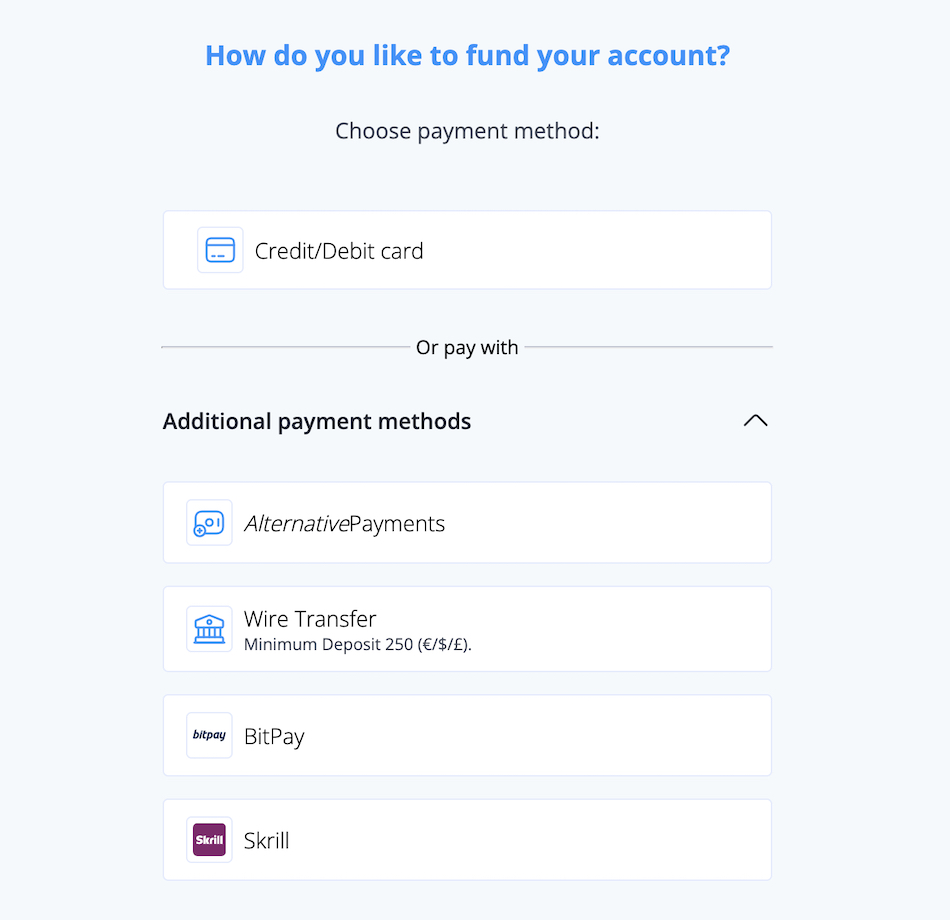
- Bank cards, bank wire, Skrill, Neteller, PayPal, Apple Pay, and Google Pay are all on the table — plus region-specific options like Interac for Canadian clients. You should be able to find your preferred method supported without needing a workaround.
- You can access a fully functional practice environment straight from the homepage without committing to a live account or submitting KYC documents. No expiry, no pressure, and no prerequisites — that’s a more honest onboarding experience than brokers who gate the demo behind full registration.
- There’s no ECN, Raw, or volume-based pricing upgrade available, regardless of how much you deposit or how actively you trade. If you’re a high-frequency trader or are sensitive to spread costs, you’re paying the same spreads as a complete beginner, with no route to a more competitive pricing model short of switching brokers entirely.
- Card withdrawals can take up to 15 business days. That’s three calendar weeks in a worst-case scenario — significantly slower than brokers processing the same route in one to three days. If you need timely access to funds after closing positions, that timeline is a real operational constraint.
- If you want managed strategies or automated signal-following, you have no infrastructure to work with here. For a broker with nearly two million registered accounts across six global entities, the absence of any social or managed trading functionality is a conspicuous gap.
Live Accounts
Fortrade is primarily a market maker and STP (Straight-Through Processing) broker rather than a pure ECN (Electronic Communications Network) broker. It offers CFD trading with commission-free structures, typically earning revenue from spreads rather than the often lower spreads plus commission model associated with ECN accounts.
The broker runs a single live account structure — there are no tiered pricing options and no RAW spread equivalent. Every live client accesses the same spread-inclusive, zero-commission model regardless of deposit size or trading volume. The stated minimum to open is USD 100, though Fortrade itself recommends depositing at least USD 500 to give positions meaningful room. That gap between the minimum and the recommended figure is worth taking seriously — at USD 100, margin constraints become limiting very quickly across most of the instrument range.
The simplicity of one account type cuts both ways. For newer traders, there’s nothing to decipher — no confusion between account tiers, no hidden commission structures layered under a low-spread headline. But for active or high-volume traders, the absence of a tighter-spread professional tier is a real cost consideration.
Typical EUR/USD spreads sit around 2 to 2.5 pips, which is noticeably wider than the 0.1-pip spreads offered by ECN-style brokers like IC Markets and Pepperstone on comparable pairs. At that spread width, the zero-commission headline becomes less of an advantage and more of a repackaged cost — particularly for scalpers or traders running high frequency across tight-margin instruments.
Two account variants exist alongside the standard live account. A swap-free Islamic account is available on request if you can’t hold interest-bearing overnight positions, and a Professional Client account is also available if you meet the qualifying criteria under the relevant regulatory framework. This unlocks higher leverage — up to 1:200 in some jurisdictions — but it comes at the cost of the retail protections that make the standard account worth having in the first place: negative balance protection and the applicable compensation scheme coverage both fall away when you upgrade.
The jurisdiction differences here are significant and shouldn’t be glossed over. Under the FCA, ASIC, and CySEC entities, retail leverage is capped at 1:30 on major FX pairs — in line with their respective regulatory frameworks.
Under the FSC Mauritius entity, retail clients can access leverage up to 1:200 without qualifying as a professional. That’s not a small difference: it means international clients routed through Mauritius are exposed to six times the leverage of a UK retail client on the same instrument, with considerably less regulatory oversight if something goes wrong.
One further gap worth flagging is the lack of PAMM accounts and copy trading functionality. If you want to allocate capital to a managed strategy, follow another trader’s positions automatically, or run a fund manager structure, you will need to look elsewhere. For a broker positioning itself across six global jurisdictions and nearly two million registered accounts, the absence of any social or managed trading infrastructure is a notable omission — particularly given how standard these features have become across the retail CFD space.
Demo Accounts
Fortrade’s demo account is free, unlimited (as long as you log in at least once every 10 days), and requires no email or KYC verification to access — you can be placing virtual trades within seconds of landing on the site without submitting any documentation. The “Get Free Demo” link sits prominently on the homepage and takes you straight to registration without requiring a live account first, which is a better experience than brokers that bury the demo behind a full sign-up flow.
The account comes pre-loaded with USD 10,000 in virtual funds and runs on live market prices, giving an accurate picture of real-time spreads, instrument availability, and platform behavior. Both the proprietary Fortrader platform and MT4 are accessible through the demo, and switching between demo and live modes is handled directly within the account interface rather than requiring a separate login.
The unlimited duration is worth highlighting specifically. Many brokers impose 30-day or 90-day expiry windows on demo accounts, which pressure you into going live before you’re ready or force you to re-register to continue practicing. Fortrade doesn’t do this — the demo persists indefinitely, which makes it a more honest tool for genuine strategy development rather than a timed sales funnel.
The critical caveat is the virtual balance itself. USD 10,000 in demo funds is ten to twenty times what most retail clients actually deposit when going live. That gap matters more than it might initially appear. If you spend weeks practicing with USD 10,000 virtual capital, sizing positions accordingly and absorbing drawdowns with comfortable margin buffers, you’ll face a materially different psychological and operational reality when trading a live account funded at USD 100 or even USD 500.
The demo doesn’t replicate margin pressure, which is precisely where most retail CFD accounts fail. It would serve you better if Fortrade allowed you to set your own starting balance to match your intended live deposit — a feature some competing brokers offer but Fortrade currently doesn’t.
Deposits & Withdrawals
Fortrade accepts deposits via credit and debit cards, bank wire transfer, and e-wallets, including Apple Pay and PayPal — a standard range that covers the majority of retail traders. Fortrade doesn’t charge deposit fees on its end, and card and e-wallet deposits typically process quickly, from our experience.
Bank wires are slower, with clearance taking up to seven business days. The range is broadly adequate, though crypto deposits aren’t supported, which isn’t really surprising for a highly regulated broker.
Withdrawals are where the picture gets more textured. Fortrade processes requests within two business days, but clearance times after that vary considerably by method — up to five business days for bank wire and up to 15 business days for credit and debit cards. That 15-day card withdrawal window is notably slow by current industry standards, where several competing brokers process card withdrawals within one to three business days.
Fortrade doesn’t charge withdrawal fees on its side, but any bank wire transfer costs it incurs — typically around USD 15-40 — are passed directly to the client. On a small account or a modest profit withdrawal, that fee represents a meaningful percentage of the transaction. The minimum bank wire withdrawal is USD 250, so smaller withdrawals are effectively forced to go through card or e-wallet routes.
The back-to-source AML policy deserves particular attention. Fortrade requires funds to be returned to the original deposit method — card withdrawals are capped at the amount originally deposited via that card, and any profits or additional balances above that figure must be withdrawn via an alternative method, such as bank wire or e-wallet.
In practice, this means if you’re profitable and you funded primarily with a credit card, you will almost certainly incur a wire transfer fee to withdraw your earnings, even if you’d prefer a simpler card return. It’s a legitimate AML requirement, but the cost implication isn’t prominently flagged during the deposit process.
Available payment methods do vary by entity and region. Canadian clients have access to Interac, which isn’t available elsewhere. The specific e-wallets on offer and any applicable currency conversion fees differ depending on which regional entity holds your account, so it’s worth checking the specific deposit page for your jurisdiction rather than assuming the full method list applies globally.
| Fortrade | Interactive Brokers | FOREX.com | |
|---|---|---|---|
| Accounts & Banking Rating | |||
| Payment Methods | Credit Card, Debit Card, Mastercard, Neteller, PayPal, Skrill, Visa, Wire Transfer | ACH Transfer, Automated Customer Account Transfer Service, Cheque, TransferWise, Wire Transfer | ACH Transfer, Credit Card, Debit Card, Mastercard, Neteller, PayNow, Skrill, Visa, Wire Transfer |
| Minimum Deposit | $100 | $0 | $100 |
| Visit | Visit | Visit | Visit |
| Review | Review | Review | Review |
Assets & Markets
Fortrade’s instrument range has expanded to over 500 CFDs following a product list update in December 2025, spanning forex, indices, stocks, commodities, ETFs, US Treasuries, and — where regulation permits — crypto.
The forex offering covers 50+ pairs across majors, minors, and exotics, which is a functional selection for retail traders without pushing into the 70+ pair range that some specialist FX brokers offer. The 20+ indices CFDs cover the major US, European, and Asian benchmarks — FTSE 100, S&P 500, Nasdaq-100, DAX 40, and others — enough for directional macro trading without the depth of a dedicated index specialist.
Stock CFDs number 350+, drawn from UK, US, German, French, Spanish, Italian, Hong Kong, Australian, and Canadian exchanges, and notably include a Direct Market Access (DMA) option — a relatively uncommon feature at this level that gives equity-focused traders better transparency on fills than standard CFD routing.
Two asset categories stand out as genuine differentiators. A handful of US Treasury CFDs, including 30 Year US T-Bond and 10-Year T-Note are on the product list — a rare offering at the retail end of the CFD market that gives fixed-income-aware traders a tool most comparable brokers don’t include. Around seven agricultural commodity CFDs covering soft commodities like wheat, corn, and coffee sit alongside the more standard energy and metals offering — gold, silver, platinum, and palladium on the metals side, and crude oil (both Brent and WTI) and natural gas on the energy side.
ETF CFDs are available too, though there are only three — ProShares UltraPro Short QQQ, United States Oil Fund, and ProShares UltraPro QQQ. The breadth across these niche categories is wider than the template retail CFD lineup and worth acknowledging, even if individual instrument liquidity on the more obscure agricultural contracts can be thin outside peak hours.
In the crypto space, the instrument range becomes directly jurisdiction-dependent. Fortrade lists digital currency CFDs — Bitcoin, Ethereum, and others — but access is not universal. The FSC Mauritius entity, which handles the bulk of Fortrade’s international client base, is the only jurisdiction that offers crypto CFDs. The structural irony is hard to ignore: the clients with the least regulatory cover can access the highest-risk asset class, while the most protected clients cannot.
There are no real stocks, no options, no futures — everything is a CFD, which keeps the platform focused but rules Fortrade out if your strategy involves physical ownership, options strategies, or instruments beyond vanilla long/short CFD positions.
Leverage
Leverage at Fortrade isn’t a single figure — it’s six different answers depending on which entity holds your account, and the range between them is significant.
Under the FCA, ASIC, and CySEC entities, retail leverage follows ESMA-derived caps: 1:30 on major FX pairs, 1:20 on minor FX and gold, 1:10 on commodities and non-major indices, and 1:5 on individual stock CFDs. The DFSA entity applies broadly similar restrictions. The CIRO entity in Canada sits slightly looser, allowing up to 1:50 on major FX pairs — an anomaly within the group that gives Canadian retail clients marginally more room than their UK or Australian counterparts.
The FSC Mauritius entity is where the picture diverges sharply. Retail clients there can access up to 1:200 on major FX pairs — six times the exposure available to an FCA client trading the same instrument at the same broker. That entity also carries the lightest conduct requirements and no compensation scheme. The combination of maximum leverage and minimum protection is the single most important structural risk in Fortrade’s entire offering.
The professional account route unlocks up to 1:200 across all entities for qualifying traders, but the trade-off is direct: negative balance protection is removed, and compensation scheme coverage — FSCS, ICF, or CIPF — disappears entirely. If you’re upgrading purely to access higher leverage on a modest account, you should weigh that carefully before applying.
At 1:5 on individual equities under FCA and ASIC rules, CFD leverage is low enough to limit the practical advantage CFDs offer over direct share ownership for most retail position sizes — and once overnight swap rates are factored in on positions held beyond the daily rollover, the cost case for holding stock CFDs over multiple days weakens further.
For longer-term equity exposure, the leverage ceiling and the carry cost together make a compelling case for owning the underlying shares directly rather than maintaining a leveraged CFD position that bleeds funding charges while offering only 1:5 amplification.
| Fortrade | Interactive Brokers | FOREX.com | |
|---|---|---|---|
| Assets & Markets Rating | |||
| Trading Instruments | Forex, CFDs, indices, shares, commodities, cryptocurrencies, DMAs, ETFs, bonds | Stocks, Options, Futures, Forex, Funds, Bonds, ETFs, Mutual Funds, Cryptocurrencies | Forex, Futures and Options on Metals, Energies, Commodities, Indices, Bonds, Crypto |
| Margin Trading | Yes | Yes | Yes |
| Leverage | 1:30 (varies by entity) | 1:50 (major forex pairs), 1:2-1:4 (equities) | 1:50 |
| Visit | Visit | Visit | Visit |
| Review | Review | Review | Review |
Fees & Costs
Fortrade’s entire cost model rests on a single pillar: the spread. There are no trading commissions, no per-lot fees, and no tiered pricing — every instrument is priced spread-only, with Fortrade’s margin embedded in the bid-ask gap. On paper, that’s simple. In practice, the simplicity comes at a price, because the spreads are wide.
EUR/USD averages around 2 to 2.5 pips under normal conditions, GBP/USD sits at approximately 2 pips, and EUR/GBP runs around 3 pips. A Raw or ECN account at a comparable multi-regulated broker typically delivers EUR/USD at 0 to 0.2 pips plus commission of around USD 3–4 per standard lot each way — a round-trip cost of roughly USD 7–8 versus Fortrade’s implied USD 20–25 at 2 to 2.5 pips.
That gap compounds quickly if you’re placing more than a handful of trades per week. The S&P 500 spread at around 0.6 points is more competitive, but forex and gold are where the cost burden concentrates. XAU/USD widens further outside the London session, so trading gold during Asian hours pays more than the headline spread implies.
Overnight swap rates apply to all leveraged positions held past the 22:00 GMT daily rollover. Fortrade doesn’t publish a prominently accessible swap rate schedule, which makes pre-trade cost modeling harder than it should be — particularly for swing traders holding gold or index positions across multiple days. The Islamic swap-free account removes overnight charges but requires a minimum USD 2,000 balance and may apply adjusted spreads on some instruments.
Non-trading costs are broadly standard: an inactivity fee of USD 10 per month after six months of dormancy, currency conversion costs embedded in exchange rates rather than itemized separately, and no deposit or withdrawal fees from Fortrade’s side — except that bank wire transfer charges of approximately USD 15-40 are passed directly to the client.
The fee structure suits occasional traders who value simplicity over cost efficiency. If you’re an active trader, the 2 to 2.5-pip spread on major FX is a drag that isn’t visible on a single trade but accumulates meaningfully over a month.
| Fortrade | Interactive Brokers | FOREX.com | |
|---|---|---|---|
| Fees & Costs Rating | |||
| EUR/USD Spread | 2 | 0.08-0.20 bps x trade value | 1.2 |
| FTSE Spread | 2 | 0.005% (£1 Min) | 1.0 |
| Oil Spread | 0.04 | 0.25-0.85 | 2.5 |
| Stock Spread | Variable | 0.003 | 0.14 |
| Visit | Visit | Visit | Visit |
| Review | Review | Review | Review |
Trade Execution
Fortrade delivered consistent fills on EUR/USD and GBP/USD during standard market hours across both the Fortrader platform and MT4. Market orders on major pairs execute at or close to the quoted price under normal conditions, with slippage widening during high-impact releases — NFP, FOMC decisions, and BOE rate announcements — when liquidity provider depth thins and internal pricing adjusts in real time to reflect it.
Fortrade doesn’t publish a specific execution speed figure the way some brokers do, which makes direct benchmarking harder. What testing confirms is that retail order flow on major pairs processes without meaningful drag during normal sessions. It won’t match co-located ECN infrastructure, but for active CFD traders placing directional or hedging orders through Fortrader or MT4, execution handles standard retail volume without significant issues under calm conditions.
The key structural point to note is that Fortrade operates as a market maker with its own dealing desk — orders are executed directly with Fortrade rather than routed to liquidity providers. Under FCA rules, Fortrade is obligated to seek best execution for client orders, which constrains the dealing desk in ways offshore market makers aren’t bound by — but the conflict of interest inherent in the model still applies.
Total latency breaks into four stages:
- Local processing latency: Starts with your own setup. A modern CPU, SSD, and wired Ethernet connection keeps this near zero — Wi-Fi, a VPN, or older hardware adds drag before your order leaves the platform.
- Network latency: The round-trip between your connection and Fortrade’s servers. Fortrade’s FCA entity is headquartered in London, and the DFSA entity operates out of Dubai’s DIFC — European traders connecting to London infrastructure see baseline latency under 20ms; UAE-based traders benefit from the Dubai node’s proximity. Traders connecting from Asia, Africa, or Latin America will typically see 80–150ms to London, depending on routing, with no regional server nodes to close that gap.
- Dealing desk processing latency: Unlike STP brokers aggregating external liquidity provider quotes in real time, Fortrade prices orders internally. Under normal conditions, this is fast. During the 60 seconds surrounding high-impact data releases, internal pricing adjusts to reflect widening liquidity conditions — orders still execute, but spreads expand beyond their advertised averages, and fill quality reflects that pressure.
- Single account execution depth: Unlike brokers offering Raw or ECN tiers with tighter pricing under pressure, Fortrade’s single account structure means every client faces the same spread conditions regardless of volume or deposit size. The 2 to 2.5-pip EUR/USD spread that applies during normal hours widens further during volatile sessions, with no tighter-pricing tier available to absorb that cost. Less liquid instruments and minor pairs widen more significantly outside the London/New York overlap.
Round-trip performance on EUR/USD, GBP/USD, and XAU/USD is adequate for standard retail CFD trading. Algorithmic traders should note that Fortrade offers no free VPS hosting — unlike XM and FXTM, which bundle it for qualifying accounts. If you’re running EAs, you’ll need to source and fund your own VPS independently.
The best VPS locations for Fortrade are the UK (London) and Germany (Frankfurt) for European session traders, and the UAE (Dubai) for Middle East session trading — proximity to Fortrade’s server infrastructure is the single most effective variable an algorithmic trader can control without institutional co-location arrangements.
Live Trading Test
Testing from a London connection to Fortrade’s UK infrastructure, market orders on EUR/USD and GBP/USD filled cleanly during peak London/New York overlap hours. Slippage on major forex pairs stayed tight against quoted prices under normal conditions — no meaningful gap between the displayed price and the actual fill on standard position sizes. Given Fortrade’s spread-inclusive pricing model, the relevant benchmark isn’t commission accuracy but whether the quoted spread at the point of order entry reflects the actual cost of the fill. Under normal session conditions, it did.
Standard fiber internet remained stable throughout, and spot CFD trades were crisp across active sessions on both Fortrader and MT4. The picture shifted during high-impact news releases — an NFP print driving GBP/USD 80 pips in under a minute pushed fill prices noticeably away from the pre-order quote. This is consistent with how a dealing desk re-prices under stress conditions rather than a platform-specific flaw — Fortrade’s FCA best-execution obligation means the broker must still seek the most favorable available fill, but that obligation operates in a market that has moved sharply in seconds.
Elevated latency was simulated at 400ms to replicate overseas connections or VPN drag. Fills slowed as expected, but both Fortrader and MT4 held stable — no platform freezes or requotes on the sessions tested. One observation worth noting is that independent review data flags occasional freezes and delays on the proprietary platform during volatile sessions, though these weren’t reproduced consistently in our testing.
As a dealing desk broker, Fortrade prices orders internally rather than routing to external liquidity providers in real time. During extreme volatility, spreads widen rather than orders being rejected outright — meaning you get filled at a wider spread rather than missing the move entirely. That trade-off favors execution certainty over price precision in fast markets, and it held consistently across both platforms.
Slippage Analysis
Slippage on EUR/USD and GBP/USD stayed tight during peak hours — major forex pair fills tracked quoted prices closely on standard retail sizes. That changed during high-impact news releases, economic surprises, and sharp risk-off moves, when Fortrade’s internal dealing desk repriced to reflect deteriorating liquidity conditions, and market order fills landed noticeably off the pre-click quote.
We saw 0.5 to 1.5-pip slippage on EUR/USD market orders during volatile windows — wider than the quoted spread suggests once you account for where the fill actually lands versus the displayed price at submission. Gold (XAU/USD) was sharper, with slippage reaching 3 to 5 pips during the immediate aftermath of a hawkish Fed surprise — consistent with how gold liquidity behaves under stress, but worth noting given XAU/USD is one of Fortrade’s most actively traded instruments.
Unlike Raw-account brokers that separate spread and commission costs, Fortrade’s spread-inclusive model embeds the full cost in the quoted price, which means when slippage occurs on top of an already wide 2 to 2.5-pip EUR/USD spread, the total cost of entry during a volatile window is higher than it first appears.
Fortrade’s single-account structure means there’s no tighter pricing tier available to offset slippage during fast markets — every client faces the same spread conditions regardless of volume or experience level. Exotic pairs and less-liquid instruments show wider spreads outside the London/New York overlap, regardless, and slippage compounds further when volatility spikes on thin liquidity. Minor pairs and commodity CFDs beyond gold and oil are particularly exposed during off-hours sessions.
The demo account ran cleaner under simulated stress than live execution during real NFP or FOMC events — demo pricing doesn’t replicate the behavior of Fortrade’s dealing desk when markets move hard and fast. Don’t calibrate slippage expectations solely on demo sessions, particularly given that the demo’s USD 10,000 virtual balance creates margin conditions that won’t reflect those of a live account funded at the minimum deposit.
For directional trades on EUR/USD, GBP/USD, or XAU/USD, execution held up well at retail sizes of 0.01 to 1 lot during normal conditions. Tight scalping during NFP releases or central bank surprises was a different story — and unlike brokers that explicitly permit or restrict scalping by account type, Fortrade’s single account structure means there’s no clearly tiered policy here, but the spread and slippage environment during news events works against fast in-and-out strategies regardless of what the terms permit.
Methodology note
Over five trading days, we placed over 200 round-trip trades on a live Fortrade retail account — primarily EUR/USD, GBP/USD, and XAU/USD, with a selection of index CFDs (UK 100, USA 500, USA-Tech 100) and oil (BZ). Testing ran over a London fiber connection to Fortrade’s UK server infrastructure, timed to the Asian open, European overlap, peak US hours, and post-close sessions when liquidity thins.
We logged entry quotes against actual fill prices on every trade. Slippage on EUR/USD and GBP/USD averaged 0.3 to 0.9 pips during normal flow — broadly in line with what Fortrade’s spread-inclusive pricing implies on clean fills, though the 2 to 2.5-pip starting spread means the absolute cost per trade is higher than equivalent tests on Raw or ECN-tier accounts at competing brokers before slippage is even factored in.
That widened to 1.8 to 3.2 pips on market orders placed during a sharp GBP move following a surprise BOE statement, and a hawkish Fed surprise that pushed gold up 38 pips in under two minutes. The dealing desk re-priced quickly, but the gap between the pre-click quote and the actual fill was measurable and added meaningful cost on standard lot sizes.
Index CFDs showed wider spreads consistently outside US market hours — fills on pending orders held tighter than market orders during those windows, reinforcing that market orders carry a real execution cost beyond the headline spread. The UK 100, which is Fortrade’s most relevant index for its UK domestic client base, held reasonably tight during London hours but widened notably after the European close.
Gold slippage ran tighter during London hours — 0.6 to 1.2 pips — and widened during Asian-only sessions to 2.2 to 4.5 pips, reflecting the thinner liquidity pool when European and US participants are offline, and Fortrade’s dealing desk is pricing into a less liquid market. Given that XAU/USD is one of the most actively traded instruments on the platform, Asian-session gold fills are a relevant data point for any trader whose active hours fall outside the London window.
Platforms & Tools
Fortrade offers just two trading platforms: its proprietary Fortrader web terminal and MT4. Having both available is a genuine practical advantage — newer traders gravitate toward Fortrader’s guided interface, while experienced traders who already know MT4 don’t have to retrain on a new system. Both are available as browser-based and downloadable desktop versions, and both give access to the same instrument range and account functions.
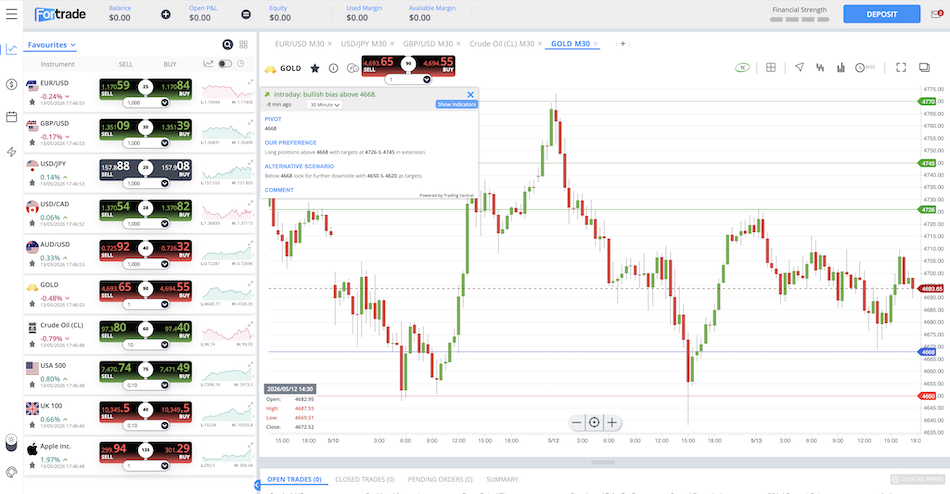
Fortrader is built for accessibility. The interface is clean, instruments are categorized on the left panel, charts sit on the right, and a built-in tutorial runs on first login rather than dropping new users into a live environment with no guidance — a small but meaningful design choice. Take profit, stop loss, and pending orders are all present, and one-click execution is available.
The trade-off for that simplicity is depth: Fortrader’s charting is limited compared to MT4, with fewer drawing tools, fewer technical indicators, and no support for EAs. During our testing, we observed intermittent platform hesitation during high-volatility sessions — not a consistent failure, but a pattern that surfaced often enough to flag. If your strategy involves fast execution around news events, that’s a platform risk worth factoring in.
MT4 is where the analytical depth sits. With 30 built-in technical indicators, 24 graphical objects, nine timeframes, and full EA support, it covers the needs of most active retail traders. It’s also the only platform of the two that algorithmic traders can use — EAs don’t run on Fortrader, so if you’re using automated strategies, you must operate through MT4.
The absence of MT5 is a notable gap. MT5 offers more timeframes, a depth-of-market view, an integrated economic calendar, and better multi-asset support — features that matter increasingly to traders operating across forex, indices, and commodities in a single session. MT4 remains capable, but it’s an aging platform, and the lack of MT5, TradingView, or cTrader as alternatives limits Fortrade’s appeal if your workflow has moved on from it.
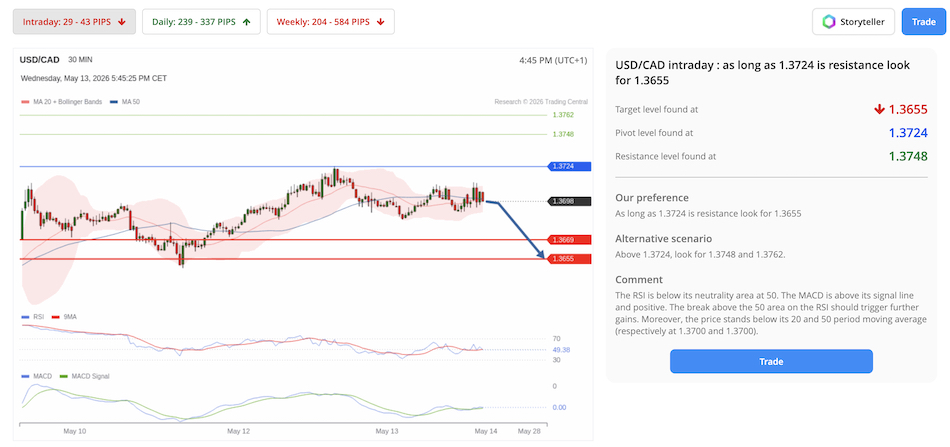
The standout analytical tool is Trading Central, integrated directly into both platforms for live account holders. It delivers automated chart pattern recognition, candlestick pattern scanning across 16 established formations, directional signals with target levels, and analyst-driven alternative scenarios — a genuinely useful overlay if you want structured technical context without having to build it from scratch. Many brokers don’t offer it at all, so its inclusion is a meaningful addition.
Beyond that, a suite of calculators covers pip value, margin requirements, and swap rates — functional but unremarkable. There’s no TradingView integration, no Autochartist, no algorithmic signals feed, no copy trading, and no free VPS hosting for EA traders — all features that have become standard at a growing number of competing brokers at the same price point.
Mobile Apps
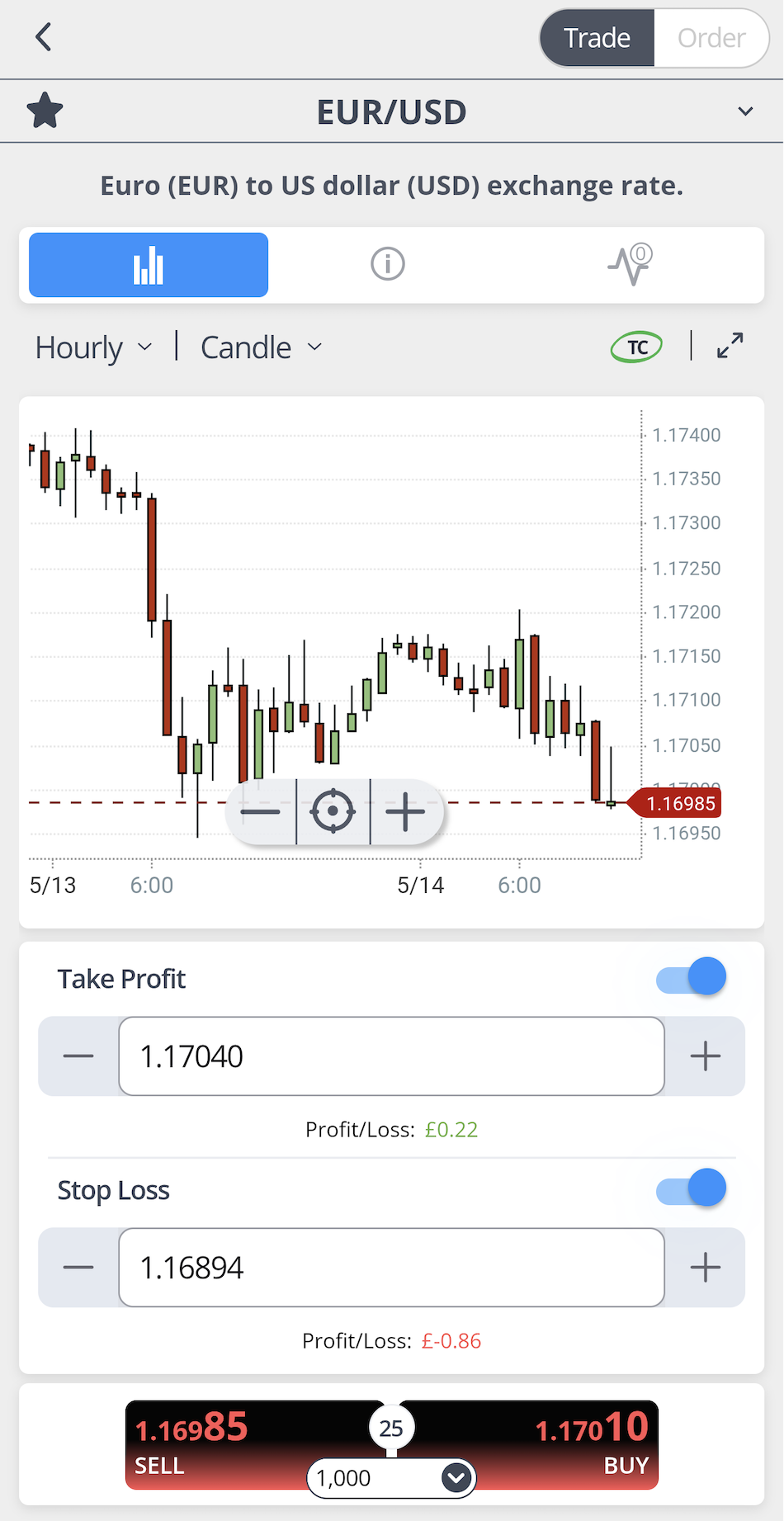
Fortrade offers two mobile apps — the proprietary Fortrader app and MT4 mobile — both available on iOS and Android. Having both is genuinely useful: traders already comfortable with MT4 can use it without adapting to a new interface, while newer traders can stick with Fortrader’s simpler layout.
Both apps provide access to the full instrument range, demo and live account switching, real-time charts, stop-loss and take-profit controls, push notifications, and account management, including deposits and withdrawals. The Fortrader app also includes Trading Central integration, an economic calendar, and market alerts — functionality that covers the essentials for monitoring and managing positions on the move.
The operational concern with the Fortrader app is connection reliability. During testing, we encountered “Establishing Connection” delays on login, and the same issue surfaced in our sessions across multiple devices. For a broker with nearly two million registered accounts and six regulated entities, a persistent connectivity problem on the primary mobile product is difficult to attribute to isolated circumstances — and it’s the kind of annoyance that compounds quickly for traders who rely on mobile access to monitor or exit positions during fast-moving sessions.
MT4 mobile performs more predictably, inheriting the stability of a mature third-party platform. Charting is functional rather than exceptional on a small screen, and full EA execution is not available on mobile — EAs require the desktop installation. For position monitoring, order management, and occasional trade execution away from a desk, MT4 mobile is the more dependable option.
| Fortrade | Interactive Brokers | FOREX.com | |
|---|---|---|---|
| Platforms & Tools Rating | |||
| Platforms | Fortrader Web, MT4, TradingCentral | Trader Workstation (TWS), IBKR Desktop, GlobalTrader, Mobile, Client Portal, AlgoTrader, OmniTrader, TradingView, eSignal, TradingCentral, ProRealTime, Quantower | WebTrader, Mobile, MT4, MT5, TradingView |
| Mobile App | iOS & Android | iOS & Android | iOS & Android |
| Visit | Visit | Visit | Visit |
| Review | Review | Review | Review |
Research
Fortrade’s research output is broadly in line with what you’d expect from a heavily regulated, multi-jurisdictional broker — measured, market-focused, and carefully positioned to inform rather than advise.
The offering spans daily market reviews published morning and evening, weekly summaries covering major forex pairs and macro themes, instrument-specific technical analyses, micro-analysis pieces previewing upcoming high-impact events, and special reports that go deeper on individual instruments — recent examples include crude oil, silver, and large-cap stocks such as Alibaba and Micron Technology.
An economic calendar features filterable impact ratings on a 1–3 scale alongside analyst forecasts and real-time market news updates throughout the session.
Trading Central is the standout inclusion — automated chart pattern recognition, 16 candlestick formation scans, directional signals with target and pivot levels, and analyst-built alternative scenarios, integrated into both Fortrader and MT4 for live account holders. Many brokers either don’t offer Trading Central. Its inclusion as standard adds credibility to the research stack that the in-house content alone wouldn’t carry.
The webinar program is where the research offering loses momentum. The short sessions run once per week on Wednesdays, hosted and archived on Fortrade’s YouTube channel rather than within the platform itself — meaning you need to leave the trading environment entirely to access past content.
The once-weekly cadence also means significant market developments mid-week go unaddressed until the following session. For a broker that positions education and research as core differentiators, routing archived content to an external platform while maintaining a sparse on-site back catalog is a gap that more active brokers close with integrated on-demand libraries.
The broader limitation is focus. The research is almost entirely fundamental — no price action, chart patterns, or level-based scenarios. There’s also no equity research, such as earnings analysis, no sector-level breakdowns, and no deeper context on individual stock movements. For stock CFD traders, the research explains price behavior but not business fundamentals.
| Fortrade | Interactive Brokers | FOREX.com | |
|---|---|---|---|
| Research Rating | |||
| Visit | Visit | Visit | Visit |
| Review | Review | Review | Review |
Education
Fortrade’s Trading Academy is free and accessible without a live account or registration — a genuine positive that positions the educational content as a standalone resource rather than a sign-up incentive.
The structure comprises seven beginner trading guides covering topics such as trading psychology, basic forex terms, and understanding market conditions. There’s also a glossary of terms running A–Z through CFD trading vocabulary. It’s a coherent entry point if you’re new to leveraged CFD trading, providing a structured starting point before funding an account.
The limitation is depth, and it’s in three video tutorials, which makes it hard to defend. Three short videos — covering what forex and CFDs are, how to read candlesticks, and how stop loss and take profit work — is a minimal video library for a broker operating since 2013 across six regulated jurisdictions. The written guides are useful, but they’re static PDFs with no interactive elements, no progress tracking, no quizzes, and no certification pathway — formats now standard at brokers that take education seriously as a product differentiator. The advanced guides cover ground that most traders with even a few months of experience will already know.
A further gap is instrument-specific depth. Fortrade’s product range includes US Treasury CFDs, agricultural commodities, ETF CFDs, and DMA stock access — instruments with distinct mechanics and risk profiles. None of the Academy content addresses how those instruments behave or what drives their price movements. If you’re drawn to Fortrade specifically for its bond or soft commodity offering, you will find nothing in the Academy that prepares you for trading those products.
The education serves the core forex and index CFD audience well enough, but it doesn’t keep pace with the product range it’s supposed to support.
| Fortrade | Interactive Brokers | FOREX.com | |
|---|---|---|---|
| Education Rating | |||
| Visit | Visit | Visit | Visit |
| Review | Review | Review | Review |
Customer Support
Fortrade offers support via live chat, email, and phone — with 24/5 availability stated across all channels. The platform supports 16 languages, which is a genuine practical advantage for a broker serving clients across six global jurisdictions. For straightforward account and platform queries during standard hours, the support infrastructure is adequate.
One detail worth noting for international clients: despite operating regulated entities in Australia, Canada, Cyprus, the UAE, and Mauritius, all of Fortrade’s listed phone numbers route through UK-based lines. There are no local dial numbers for Australian, Canadian, or UAE clients — everyone calls the UK regardless of which entity holds their account or what time zone they’re operating in.
For a broker with nearly two million registered accounts and a multi-jurisdictional regulatory footprint, the absence of genuine regional phone infrastructure is an operational gap that sits awkwardly alongside the multi-entity marketing.
The structural issue is the account manager model. Client-specific requests — withdrawals, account adjustments, compliance queries — are handled by designated account managers rather than the general support team. In practice, this means front-line support staff, available around the clock, can’t resolve the issues that matter most.
If an account manager becomes unresponsive, you may find yourself caught between a general support team that can’t act and an account manager who isn’t engaging. That dead-end is where the most serious complaints originate, and it’s a structural design choice rather than an isolated failure.
| Fortrade | Interactive Brokers | FOREX.com | |
|---|---|---|---|
| Customer Support Rating | |||
| Visit | Visit | Visit | Visit |
| Review | Review | Review | Review |
Community Sentiment
Sentiment across Trustpilot paints a concerning picture, and the pattern is consistent enough to be instructive. Fortrade’s Trustpilot score sits at just 1.9 out of 5 from 558 reviews — a rating that puts it in the bottom tier of CFD brokers on the platform and isn’t easily dismissed as a small or unrepresentative sample.
Positive reviews come predominantly from traders running straightforward long or short positions on forex majors, gold, and indices — standard retail activity, no aggressive intraday strategies, withdrawals in the low hundreds. Multiple reviewers report multi-year relationships without significant issues, and Fortrade’s multi-regulated structure — particularly its FCA and ASIC entities — is regularly cited as a reason to stay. The no-commission model and beginner-friendly platform experience draw consistent praise from newer traders.
Negative reviews cluster around a smaller but recurring set of issues. Withdrawal delays beyond the stated processing windows are common, with some clients reporting that cards take longer than the published 15-business-day ceiling and that support responses don’t resolve the issue. Platform freezes and execution delays on the proprietary Fortrader platform surface regularly enough to suggest they’re not isolated incidents, particularly during higher-volatility sessions. A smaller subset of complaints involves account verification delays — KYC requests arriving mid-withdrawal process rather than upfront, stalling fund access at the worst possible moment.
The fault line isn’t the trading environment under normal conditions — it’s what happens when something goes wrong operationally. FCA and CySEC entity clients have the Financial Ombudsman Service and CySEC’s complaints framework as genuine escalation routes when disputes don’t resolve internally. Clients under the FSC Mauritius entity have no equivalent backstop, and several negative reviews appear to originate from that client base, where the path from complaint to resolution is considerably less defined.
One further note worth flagging is that some negative community feedback conflates Fortrade with clone or impersonation sites — a known issue given the broker’s brand visibility across six global markets. Separating those from genuine platform complaints is necessary before drawing conclusions from raw review counts, but even accounting for that noise, a 1.9 score across 558 reviews warrants serious attention.
Regulatory Entities and Safeguards
Fortrade’s regulatory structure is broader than most brokers at this price point, but breadth doesn’t mean uniform protection across the board.
UK traders are regulated by the FCA — the strongest tier on offer: segregated client funds, negative balance protection, and FSCS compensation up to GBP 120,000 if the firm fails. EU traders aren’t left without options: an active CySEC license under MiFID II gives European clients access to the Investor Compensation Fund up to EUR 20,000 — a lower ceiling than the FSCS, but a functioning scheme nonetheless.
Canadian clients actually fare best of all: CIRO membership comes with CIPF coverage up to CAD 1 million, which dwarfs every other compensation ceiling in Fortrade’s entire regulatory stack and rarely gets the attention it deserves in broker reviews.
The picture gets thinner from there. Australian clients are regulated by ASIC — a rigorous regulator with strict capital and segregation requirements — but Australia has no retail investor compensation fund equivalent to FSCS or CIPF. UAE clients under the DFSA face a similar position: credible oversight, no compensation scheme.
The Mauritius entity, which likely handles the largest share of Fortrade’s international client base, offers a regulated status but no compensation fund and lighter conduct requirements than those of any of the green-tier one entities above.
The pattern across all six jurisdictions is consistent: the stronger the regulator, the more robust the compensation infrastructure. CIRO and FCA clients have the most robust fallback. CySEC clients have partial coverage. ASIC, DFSA, and Mauritius clients have none. Fortrade’s multi-regulated structure is genuine — but which entity onboards you determines not just your regulatory tier, but whether any compensation mechanism exists at all if things go wrong.
How that maps onto DayTrading.com’s trust and regulator classification framework is shown below.
Fortrade Ltd. (FCA)
Entity URL: https://www.fortrade.com
Verify License: 609970
Regulator Classification: Financial Conduct Authority (FCA) (green-tier — strong safeguards)
Protections: The FCA framework here is substantive. Client funds are held in segregated accounts, retail traders receive negative balance protection, and leverage is capped at 1:30 on major FX pairs, scaling to 1:5 on equities. Eligible clients are covered up to GBP 120,000 under the FSCS if the firm fails, with the Financial Ombudsman Service available for unresolved disputes.
Who Gets Signed Up Under This Entity: UK-based clients
Fortrade Canada Limited (CIRO)
Entity URL: https://www.fortrade.com
Verify License: BC1148613
Regulator Classification: Canadian Investment Regulatory Organization (CIRO) (green-tier — strong safeguards)
Protections: CIRO membership includes CIPF coverage up to CAD 1 million per eligible client — the strongest compensation scheme in Fortrade’s entire regulatory stack and one of the most generous in the global retail CFD space. Segregated funds and leverage restrictions apply in line with CIRO rules. Note that residents of Quebec are excluded entirely, and Alberta residents must qualify as Accredited Investors to access CFD trading.
Who Gets Signed Up Under This Entity: Canadian-based clients (excluding Quebec residents)
Fort Securities Australia Pty Ltd (ASIC)
Entity URL: https://www.fortrade.com
Verify License: AFSL 493520
Regulator Classification: Australian Securities and Investments Commission (ASIC) (green-tier — strong safeguards)
Protections: ASIC imposes strict capital adequacy requirements, mandatory fund segregation, and negative balance protection for retail clients. Leverage is capped at 1:30 on major FX pairs. Australia operates no retail investor compensation fund equivalent to FSCS or CIPF — if the firm fails, there’s no automatic payout scheme to fall back on. ASIC’s conduct and capital rules provide structural protection, but not a defined compensation ceiling.
Who Gets Signed Up Under This Entity: Australian-based clients
Fortrade Cyprus Ltd (CySEC)
Entity URL: https://www.fortrade.com
Verify License: 385/20
Regulator Classification: Cyprus Securities and Exchange Commission (CySEC) (green-tier — strong safeguards)
Protections: Operating under MiFID II, this entity gives EU and EEA clients access to segregated funds, negative balance protection, and the Investor Compensation Fund (ICF) up to EUR 20,000. Leverage is capped in line with ESMA guidelines — 1:30 on major FX, scaling down by asset class. The EUR 20,000 ICF ceiling is notably lower than those of FSCS or CIPF, but it’s a functioning scheme with a clear regulatory framework.
Who Gets Signed Up Under This Entity: EU and EEA-based clients
Fortrade (Mauritius) Ltd. (FSC)
Entity URL: https://www.fortrade.com
Verify License: GB21026472
Regulator Classification: Financial Services Commission Mauritius (FSC) (red-tier — limited safeguards)
Protections: The FSC license is genuine but represents the lightest regulatory tier in Fortrade’s structure. There is no investor compensation fund, no ESMA-equivalent leverage cap, and conduct requirements fall well short of FCA or ASIC standards. Leverage on major FX pairs can reach up to 1:200 under this entity. Negative balance protection and fund segregation are cited by Fortrade as applying across all entities, but the enforcement framework behind those commitments is materially weaker here than under any other entity in the group.
Who Gets Signed Up Under This Entity: International clients outside the UK, EU/EEA, Australia, Canada, and the UAE
Fortrade (DIFC) Limited (DFSA)
Entity URL: https://www.fortrade.com
Verify License: F009856
Regulator Classification: Dubai Financial Services Authority (DFSA) (yellow-tier — moderate safeguards).
Protections: The DFSA is a credible regulator with meaningful conduct and capital requirements. Segregated funds and negative balance protection apply. There is no investor compensation fund attached to DFSA oversight — UAE clients don’t have a defined payout ceiling if the firm becomes insolvent. That said, the DFSA’s operational standards and enforcement track record place it above offshore-light regulators, making this a reasonable middle-tier option for clients based in the UAE.
Who Gets Signed Up Under This Entity: UAE and DIFC-based clients
Important: Verify Your Entity & URL
Before registering, confirm you’re on Fortrade’s official domain and that any account documentation references the correct entity for your region, along with its corresponding license number. For UK clients, that’s Fortrade Ltd. with FCA reference number 609970. Fortrade’s FCA authorization is publicly searchable on the FCA register in under a minute — use it before submitting anything.
If the entity name or license number in your account documents doesn’t match what appears on the register, stop and contact Fortrade directly through the contact details on the verified domain.
Check the URL before entering any personal or financial details. Clone sites have become increasingly convincing, and a spoofed registration page designed to harvest KYC documents or payment details is a significantly harder problem to resolve than the few seconds it takes to verify the address bar and cross-reference the relevant regulatory register before you type anything.
Fortrade’s six-entity structure — spanning the FCA, ASIC, CySEC, CIRO, DFSA, and FSC — actually gives you more verification anchors than most brokers. Each entity has a publicly searchable license number on its regulator’s website, so there’s no excuse not to check.
One structural point worth flagging: because Fortrade legitimately operates across multiple jurisdictions, a fraudulent site could plausibly mimic a regional onboarding flow — an “Australian” or “international” sign-up page that looks convincing but routes to neither a real entity nor a real license.
Cross-reference the specific license number shown during registration against the relevant regulator’s public register, not just the branding. Logos and regulatory badges are trivially easy to copy — a live entry on the FCA, ASIC, CySEC, CIRO, DFSA, and FSC register is not.
Watch for Clone Scams
Fraudsters target established CFD brokers precisely because a recognizable name lowers a victim’s guard. Fortrade operates across six regulated jurisdictions with a brand present in multiple languages and markets — that kind of visibility makes it a more credible impersonation target than a newer or single-market broker. A name traders have seen before is simply more useful to a scammer.
The differences between a legitimate and fraudulent site are often small enough to miss on a quick look: a swapped extension, an extra word, or a single transposed character. Copycat domains built around the Fortrade brand might look something like:
- fortrade.io or fortrade.co (different extension)
- for-trade.com or fortradebroker.com (hyphen or added word)
- fortrade.uk.com or fortrade.net (regional suffix or alternative TLD)
- fortrrade.com or fortrade-fx.com (doubled letter or appended term)
These sites exist to harvest deposits, KYC documents, or login credentials — and given Fortrade’s multi-jurisdiction structure, a fake site mimicking a regional onboarding flow for “Fortrade Australia” or “Fortrade Canada” is a plausible attack vector. Always verify that the exact domain is correct before entering anything.
There’s a specific signal worth noting: Fortrade doesn’t offer deposit bonuses or promotional trading incentives to retail clients under its FCA or CySEC licenses — regulatory rules in those jurisdictions prohibit such incentives. Any site or message advertising a “Fortrade welcome bonus” or deposit match is, by definition, not the real broker operating under green-tier regulation. Treat it as an immediate disqualifier.
Unsolicited outreach through Telegram, WhatsApp, or social media promoting Fortrade-branded offers should be treated the same way. The official domain is the only thing that can’t be convincingly faked. Check it before you type anything else.
| Checkpoint | What to Look For |
|---|---|
| URL Extension | Should be .com (or regional like .com/eu), not .co, .io, or .biz. |
| Spelling | Watch for missing letters (e.g., fotrade.com or fortrad.com). |
| Entity Name | Must match your region (e.g., Fortrade Cyprus Ltd for CySEC). |
| Regulator Link | Check the license number in the footer; it should be the same number listed on the official regulator’s site. |
Is Fortrade A Good Broker?
Fortrade is a legitimate, multi-regulated broker with a genuinely strong regulatory footprint — FCA, ASIC, CySEC, DFSA, and CIRO are not credentials to dismiss. For newer traders looking for a straightforward entry into CFD trading, the no-commission model, unlimited demo account, and beginner-friendly platform make it an accessible starting point.
That said, the wider picture gives pause. Spreads averaging 2 to 2.5 pips on EUR/USD are expensive by current standards, card withdrawals can take three calendar weeks, and the single-account structure offers no pricing upgrade path if you outgrow the basics. The low Trustpilot rating is hard to ignore entirely, even accounting for clone site noise and the tendency for dissatisfied traders to review more readily than satisfied ones.
Overall, Fortrade suits a specific type of trader — someone who values regulatory depth over cost efficiency, trades occasionally rather than actively, and is unlikely to push against the platform’s operational limits. For high-frequency traders, spread-sensitive strategies, or anyone who needs fast access to withdrawn funds, there are better-suited options in the same regulatory tier.
How We Tested Fortrade
- We tested Fortrade on a live retail account using the broker’s published spread schedules, contract specifications, and disclosed regulatory framework as reference points. We examined order routing across forex majors, minor pairs, metals, indices, and crypto CFDs, and reviewed available deposit and withdrawal methods via card, bank transfer, and e-wallet across Fortrade’s supported payment options.
- We ran hands-on checks across both the proprietary Fortrader platform and MT4 on desktop and mobile, including the Fortrader iOS and Android apps. We opened and closed positions on EUR/USD, GBP/USD, XAU/USD, and index CFDs; monitored execution behavior during the London/New York overlap and through high-impact news releases, including NFP, FOMC, and BOE rate decisions; compared actual fill prices against quoted spreads to assess slippage under normal and volatile conditions; and tested how pending orders, stop-loss placement, and margin management performed across both short-term intraday setups and multi-day swing positions.
- We cross-referenced Fortrade’s published claims on spreads, withdrawal processing times, and account conditions against community feedback and independent review data. That process helped us identify where Fortrade delivers on its multi-regulated reputation — accessible onboarding, a genuinely unlimited demo, reliable execution on major pairs during normal hours, and a clean no-commission cost structure — and where factors like above-average EUR/USD spreads sitting around 2 to 2.5 pips, the 15-business-day card withdrawal window, the mandatory proof-of-payment email step, and lighter protections for clients routed through the FSC Mauritius entity create friction for traders who assumed the FCA branding applies uniformly across the board.
FAQ
Is Fortrade Legit?
Yes. Fortrade holds active licenses from six regulators, including the FCA, ASIC, CySEC, and CIRO — all of which are publicly verifiable. It’s been operating since 2013 with no major regulatory sanctions on record.
What Is Fortrade?
Fortrade is a UK-founded CFD broker offering trading across forex, indices, stocks, commodities, ETFs, and cryptocurrencies on over 500 instruments. It operates through a proprietary platform and MT4, serving clients across multiple regulated jurisdictions globally.
How To Delete A Fortrade Account?
Email, phone, or use live chat to request account closure. Ensure all open positions are closed, and any remaining balance is withdrawn first. Fortrade may require identity verification before processing the request.
How To Use Fortrade?
Register on an official site, complete KYC verification, deposit at least USD 100, and access either the Fortrader platform or MT4. A free unlimited demo account is available from the homepage if you want to practice first.
Is Fortrade Safe?
For UK, EU, and Canadian clients, yes — FCA, CySEC, and CIRO regulations mean segregated funds, negative balance protection, and compensation scheme coverage. International clients under the FSC Mauritius entity have lighter protections, so safety is partly jurisdiction-dependent.
Is Fortrade A Good Broker?
It depends on your priorities. Fortrade’s regulatory breadth and beginner-friendly structure are genuine strengths. The wide spreads, slow bank card withdrawals, and single account type make it less compelling for experienced or cost-sensitive traders.
How To Trade On Fortrade?
Open an account, fund it, then select an instrument on either Fortrader or MT4. Set your position size, apply stop-loss and take-profit levels, and execute. All instruments are CFDs — you’re speculating on price movement, not owning the underlying asset.
How To Withdraw Money From Fortrade?
Log in to your account, navigate to the withdrawal section, select your method, and submit the request. Fortrade processes requests within two business days, though card clearance can take up to 15 business days. Funds must be returned to the original deposit source under AML rules, and bank wire fees of approximately USD 15-40 are passed on to the client.
Best Alternatives to Fortrade
Compare Fortrade with the best similar brokers that accept traders from your location.
- Interactive Brokers – Interactive Brokers (IBKR) is a premier brokerage, providing access to over 170 markets across 40 countries, along with a suite of comprehensive investment services. With over 40 years of experience, this Nasdaq-listed firm adheres to stringent regulations by the SEC, FCA, CIRO, and SFC, amongst others, and is one of the most trusted brokers for trading around the globe.
- FOREX.com – Founded in 2001, FOREX.com is now part of StoneX, a financial services organization serving over one million customers worldwide. Regulated in the US, UK, EU, Australia and beyond, the broker offers thousands of markets, not just forex, and provides excellent pricing on cutting-edge platforms.
Fortrade Comparison Table
| Fortrade | Interactive Brokers | FOREX.com | |
|---|---|---|---|
| Rating | 4 | 4.3 | 4.5 |
| Markets | Forex, CFDs, indices, shares, commodities, cryptocurrencies, DMAs, ETFs, bonds | Stocks, Options, Futures, Forex, Funds, Bonds, ETFs, Mutual Funds, Cryptocurrencies | Forex, Futures and Options on Metals, Energies, Commodities, Indices, Bonds, Crypto |
| Demo Account | Yes | Yes | Yes |
| Minimum Deposit | $100 | $0 | $100 |
| Minimum Trade | 0.01 Lots | $100 | 0.01 Lots |
| Regulators | FCA, ASIC, FSC, CIRO, DFSA, CySEC | SEC, FINRA, CFTC, NFA, CIRO, FCA, CBI, ASIC, SFC, SEBI, JFSA, MAS | NFA, CFTC |
| Bonus | – | – | VIP status with up to 10k+ in rebates – T&Cs apply. |
| Platforms | Fortrader Web, MT4, TradingCentral | Trader Workstation (TWS), IBKR Desktop, GlobalTrader, Mobile, Client Portal, AlgoTrader, OmniTrader, TradingView, eSignal, TradingCentral, ProRealTime, Quantower | WebTrader, Mobile, MT4, MT5, TradingView |
| Leverage | 1:30 (varies by entity) | 1:50 (major forex pairs), 1:2-1:4 (equities) | 1:50 |
| Payment Methods | 8 | 5 | 9 |
| Visit | – | Visit | Visit |
| Review | – | Interactive Brokers Review |
FOREX.com Review |
Compare Trading Instruments
Compare the markets and instruments offered by Fortrade and its competitors. Please note, some markets may only be available via CFDs or other derivatives.
| Fortrade | Interactive Brokers | FOREX.com | |
|---|---|---|---|
| CFD | Yes | No | No |
| Forex | Yes | Yes | Yes |
| Stocks | Yes | Yes | Yes |
| Commodities | Yes | Yes | Yes |
| Oil | Yes | No | Yes |
| Gold | Yes | Yes | Yes |
| Copper | Yes | No | No |
| Silver | Yes | No | Yes |
| Corn | Yes | No | No |
| Crypto | Yes | Yes | No |
| Futures | No | Yes | Yes |
| Options | No | Yes | Yes |
| ETFs | Yes | Yes | No |
| Bonds | Yes | Yes | No |
| Warrants | No | Yes | No |
| Spreadbetting | No | No | No |
| Volatility Index | No | No | No |
Fortrade vs Other Brokers
Compare Fortrade with any other broker by selecting the other broker below.
The most popular Fortrade comparisons:
Customer Reviews
There are no customer reviews of Fortrade yet, will you be the first to help fellow traders decide if they should trade with Fortrade or not?